
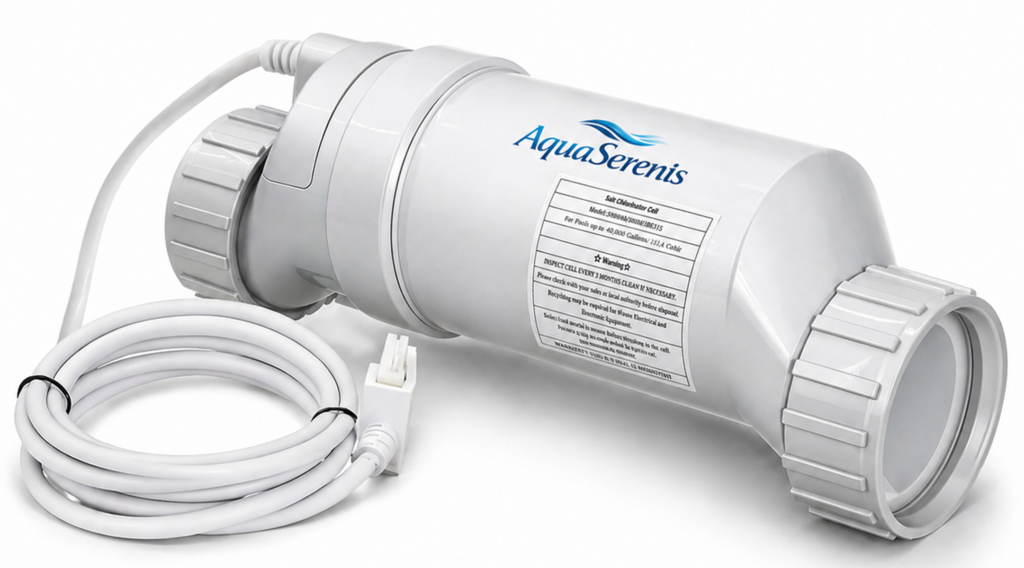
For a broader overview of salt chlorination systems, read our guide on how to choose the right salt chlorinator for your pool.
Salt cell cleaning is an important part of maintaining a pool salt chlorination system. A salt cell helps generate chlorine from dissolved salt in the pool water, but over time, scale buildup and water chemistry issues can reduce its performance.
How often you should clean a pool salt cell depends on water balance, calcium hardness, pH, usage, climate, and the condition of the pool system. Some salt cells may need only occasional cleaning, while others may require more frequent inspection in areas with hard water or high scale formation.
This guide explains when to inspect a pool salt cell, what signs may indicate cleaning is needed, and how proper maintenance can help support more consistent chlorine output.
Why Salt Cell Cleaning Matters
A pool salt cell works as water flows through the salt chlorination system. Inside the cell, the system helps convert salt into chlorine while the pool circulation system is operating.
If scale builds up on the cell plates, chlorine generation may become less efficient. The system may need to run longer, show warning alerts, or produce less chlorine than expected.
Regular inspection and proper cleaning can help:
- Support stable chlorine output
- Reduce scale-related performance issues
- Help the system operate more efficiently
- Reduce unnecessary service concerns
- Extend the useful life of the salt cell
- Help pool owners identify problems earlier
Salt cell cleaning should be done only when needed and according to the product instructions. Over-cleaning or using harsh methods may shorten cell life.
How Often Should You Inspect a Salt Cell?
For many residential pools, the salt cell should be inspected regularly during the swimming season. The exact schedule depends on water conditions and system usage.
A practical starting point is to inspect the salt cell every few months, especially during warmer months when the pool is used more often. Pools with hard water, high calcium hardness, high pH, or heavy use may need more frequent inspection.
You may need to inspect the salt cell sooner if you notice:
- Low chlorine output
- “Check Cell” warning
- Scale buildup visible inside the cell
- Cloudy water
- Increased need for manual chlorine
- Reduced system performance
- Salt chlorinator running at high output more often
Inspection does not always mean cleaning is required. If the cell is clean and chlorine output is normal, unnecessary cleaning should be avoided.
What Causes Scale Buildup?
Scale buildup is commonly related to water chemistry. When pH, calcium hardness, alkalinity, or other water balance factors are outside the recommended range, minerals can collect on the salt cell plates.
Common factors that may contribute to scale include:
- High pH
- High calcium hardness
- High alkalinity
- Hard water
- Warm water temperature
- Poor water balance
- Infrequent water testing
- Long operating periods
- Improper chemical adjustment
Scale buildup can reduce the cell’s ability to generate chlorine efficiently. In some cases, the control system may show warning lights or reduced output alerts.
Maintaining proper water balance is one of the best ways to reduce frequent scale buildup.
Signs Your Salt Cell May Need Cleaning
A salt cell may need cleaning when visible scale buildup appears or when system performance changes. However, pool owners should check basic water chemistry before assuming the cell is dirty.
Common signs include:
- White or gray scale on the cell plates
- Lower chlorine levels than usual
- Check cell warning light
- Reduced chlorine output
- Cloudy pool water
- System alerts after normal operation
- Chlorinator set high but chlorine remains low
- Frequent need for manual chlorine
These signs can also be caused by other problems, such as low salt level, short pump runtime, poor water balance, dirty filters, or a worn salt cell.
If cleaning does not improve performance, read our guide on how to tell if your salt cell needs replacement.
Cleaning Frequency Depends on Water Conditions
There is no single cleaning schedule that applies to every pool. Some pool owners may only need to clean the cell occasionally, while others may need to clean it more often due to hard water or heavy scale formation.
Salt cell cleaning frequency can be affected by:
- Local water hardness
- Pool water balance
- Pool usage
- Water temperature
- Calcium hardness
- pH level
- Pump runtime
- Chlorinator output setting
- Salt cell age
- Maintenance habits
If scale returns quickly after cleaning, the root cause may be water chemistry rather than the cell itself. In that case, water balance should be corrected before repeated cleaning.
Avoid Over-Cleaning the Salt Cell
Cleaning a salt cell too often may reduce its useful life. Chemical cleaning can remove scale, but frequent or unnecessary cleaning may also affect the cell plates over time.
Before cleaning, inspect the cell carefully. If there is no visible scale and the system is working normally, cleaning may not be needed.
Avoid:
- Cleaning on a fixed schedule without inspection
- Using strong chemical solutions unless instructed
- Scraping the plates with metal tools
- Soaking longer than recommended
- Cleaning repeatedly without checking water balance
Always follow the product manual or consult a qualified pool professional if you are unsure.
Basic Salt Cell Cleaning Guidance
The exact cleaning method depends on the salt cell model and manufacturer instructions. Pool owners should always follow the product manual for their specific system.
General cleaning guidance usually includes:
- Turn off power to the pool equipment
- Remove the salt cell according to instructions
- Inspect for visible scale buildup
- Rinse with clean water when appropriate
- Use approved cleaning methods only when needed
- Avoid damaging the cell plates
- Reinstall the cell securely
- Check for leaks after restarting the system
- Test pool water after cleaning
For electrical, plumbing, or complex system work, consult a qualified pool professional.
Check Water Balance After Cleaning
After cleaning a salt cell, pool owners should test and adjust water chemistry. Cleaning the cell may improve performance, but poor water balance can cause scale to return quickly.
Important water parameters to monitor include:
- Salt level
- Free chlorine
- pH
- Stabilizer
- Total alkalinity
- Calcium hardness
- Water temperature
- Flow and circulation
If chlorine output remains low after cleaning and water balancing, the issue may be related to salt cell wear, system compatibility, flow problems, or control unit performance.
When Cleaning May Not Be Enough
Cleaning can help remove scale buildup, but it cannot fix every salt cell problem. If the cell is old, worn, damaged, or no longer generating enough chlorine, replacement may be needed.
Cleaning may not solve the issue if:
- Chlorine output remains low after cleaning
- Warning lights return quickly
- Cell plates appear damaged
- Scale buildup is severe and repeated
- The cell is several years old
- The system requires frequent manual chlorine
- Water balance and salt level are correct but output is still weak
If you are considering a replacement, make sure to check pool replacement part compatibility before purchase.
How Maintenance Helps Reduce Replacement Risk
Good maintenance can help support longer salt cell service life. Regular water testing, correct salt level, proper pH control, and timely inspection can reduce stress on the cell.
Helpful maintenance habits include:
- Test pool water regularly
- Keep pH within the recommended range
- Maintain proper salt level
- Monitor calcium hardness
- Keep filters clean
- Ensure proper water flow
- Inspect the salt cell during the season
- Clean only when needed
- Watch for system alerts
A properly maintained salt chlorination system is more likely to deliver stable chlorine output and fewer unexpected performance issues.
When to Contact AquaSerenis Support
If you are not sure whether your salt cell needs cleaning, replacement, or compatibility review, contact AquaSerenis support before purchasing a replacement part.
Please include:
- Salt cell model
- Control unit model
- Part number
- Photos of the cell label
- Photos of visible scale buildup
- Photos of the control panel
- Warning lights or error messages
- Current pool water test results if available
- Pool volume and system type
You can also review AquaSerenis pool equipment categories on our Products page before contacting support.
Final Thoughts
Salt cell cleaning should be based on inspection, water conditions, and system performance rather than a fixed schedule alone. A pool salt cell may need cleaning when visible scale buildup appears or when chlorine output drops due to scale-related issues.
However, cleaning too often or using improper methods can reduce cell life. Pool owners should maintain proper water balance, inspect the cell regularly, and follow the product instructions.
If cleaning does not restore performance, the issue may be related to salt cell wear, system compatibility, water chemistry, or equipment condition.
Frequently Asked Questions
How often should I clean my pool salt cell?
The cleaning frequency depends on water chemistry, calcium hardness, pH, pool usage, and scale buildup. Inspect the cell regularly and clean only when visible scale or performance issues indicate cleaning is needed.
Can I clean a salt cell too often?
Yes. Cleaning too often or using harsh methods may shorten the useful life of the salt cell. If there is no visible scale and the system works normally, cleaning may not be necessary.
What does scale buildup look like on a salt cell?
Scale buildup often appears as white, gray, or chalky deposits on the cell plates. Heavy buildup can reduce chlorine generation and may trigger system alerts.
Will cleaning a salt cell fix low chlorine?
Cleaning may help if low chlorine is caused by scale buildup. However, low chlorine can also be caused by low salt level, poor water balance, short pump runtime, dirty filters, high sunlight, or a worn salt cell.
Should I replace my salt cell if cleaning does not help?
If chlorine output remains low after cleaning, water balancing, and checking system conditions, the salt cell may be worn or damaged. Confirm compatibility before choosing a replacement.